Every move you make…

They watch you at all hours. Do you know who they are? Saad Sarfraz Sheikh goes after Pakistan’s Intelligent Sophisticated Individuals

(Courtesy: New Yorker)

They say they are everywhere. Yes, everywhere. They could be hiding under your bed, or listening to you and your wife complain about the increasing price of pampers. They could be watching you flirt with your secretary at work. They could smell your stinking socks while you sleep at night to ascertain what you did in the day. They’re even inside your laptop, monitoring every webpage you visit.

Spooks!

No, they’re not microscopic insects. They aren’t robots or super heroes either. They are, rather, Intelligently Sophisticated Individuals.

For the sake of brevity, let us employ an acronym.

Your mother could be an ISI. Haven’t you noticed how she keeps an eye on you? How often she goes through your pockets and asks weird questions about what seem to be non-issues?

Perhaps the neighbour’s dog is an ISI? Haven’t you seen how he doesn’t leave your trail, even for a second?

It turns out they could also be one of the saints of Multan, those revered beings to whom you turn after being “cursed with 7 daughters.” Have you heard about this one saint in Multan who has a small shrine in the heart of the cantonment? Legend has it that many people from Southern Punjab would visit him and seek his help in matters that ranged from choosing lottery tickets to getting their children married. The fakir, nestled in a cozy corner at a road intersection, would “bless his followers” and dance in a patched robe. After serving humanity in this way for decades, his power came to an abrupt end and he was buried at the very spot where he used to sit. It was only later that our intelligence agencies came to know the truth: the fakir was a RAW agent who had spied on the military in Multan, and his family in India did not want a burial but an “antim-sanskaar” for their dearly departed.

This is just one of the many “intelligence failures” that have taken place in Pakistan’s history; and, as far as such failures go, it is a relatively harmless one. It’s a dinnertime joke compared to the big intelligence failure currently looking us in the face.

large-p-13-c

What happens when your own intelligence starts to play double games and pursue interests that are opposed to your own? If, instead of protecting the public by interpreting signals from foreign countries, a national intelligence agency starts to meddle in the internal political workings of the country, it no longer serves a useful role. Or, to put it another way, it stops being beneficial to the public and serves only itself.

Wait, am I pointing fingers? Sorry! I don’t want my fingers to be broken.

What do you do when the cops “go bad”? How do you react when governments are toppled, coups are carried out, the people’s representatives are assassinated and thousands go missing?

How do you feel when you find out that your so-called protectors, the people whose comfort and power is financed by your taxes, actually start to sleep with the enemy? (It’s come to the point where you can define ‘enemy’ however you like: our spooks are in bed with the Americans as well as the jihadis.)

More seriously, how do you as a citizen deal with what the intelligence agencies did in Bangladesh 40 years ago and are now doing in Balochistan?

All over the world the ISI has come to be associated with deception, fear and murderous consequences. It is ironic that an institution built to gather “strategic intelligence” has now turned into a media regulator that “keeps a check on journalists” and specializes in kidnapping, torturing and killing those who seek the truth. To all those who ask for evidence, I cite only the statements and interviews of countless retired spooks who have admitted to the agency’s role in rigging elections, uniting and dividing political parties and “cleansing” the media. Such widespread manipulation has made a mess of the political process in Pakistan.

Meanwhile, dim-wits like Imran Khan are speaking cryptically of a “pre-planned conspiracy that is weakening the army and ISI”.

Really? Did Syed Saleem Shehzad, and the Chechen women in Kharotabad, and that poor kid in Karachi, all kill themselves deliberately to malign the singularly patriotic Pak Fauj?

Saad Sarfraz Sheikh is a photojournalist and musician based in Lahore.

[Published in The Friday Times : http://www.thefridaytimes.com/beta3/tft/article.php?issue=20110708&page=13]

Exodus

Ten Hindu families are said to migrate every year from Pakistan to India. But what of the poor Pakistani Hindus who don’t have the means to escape? Saad Sarfraz Sheikh attends a poignant Holi ceremony in one of the last living temples in Pakistan

Holika_19_resizePandit Bhagat Lal Khokar shivers as he tightly clutches his little sack of timber and carefully siphons kerosene. He squats on the dark courtyard and prepares a large bonfire for Holika, the night before Holi. Amid the struggle, the old man informs me, “Bonfires purify the air of evil spirits.”
Loh’s Lahore has hosted Panditjee’s family for six generations. Priesthood is inherited, and today, Bhagat Lal Khokhar is the pandit of the Valmik Mandir situated in Old Anarkali. His generation may be the last one here, as his children find solace in regular jobs and not temple duties. Living in a land obsessed with Islam, he’s had to run the temple and his house without any government support by doing odd roadside jobs.
Hindus whispering in the temple are distracted by the sight and sound of Bhagat striking a match against the ancient brick floor. As the fire towers high, we follow him into the temple.
The main room of the dimly lit temple is preserved for the worship of Baba Guru Valmik Swami (Valmiki), the supreme ‘Untouchable’ deity, and the author of the Ramayana. The other houses a prayer room with mini statues and posters.
Excited Hindu children worship the statue amid squeals of innocent cheer and laughter. Once done prostrating, they crawl and rest against the wall. Anu, a 6-year old, starts reciting a naat she said she heard at school. The pandit’s wife rushes in and silences her, warning her of dire consequences and unforgivable punishment if the Maharaaj (Panditjee) finds out. But the maharaaj is busy, immersed in praying and blessing everyone.

Holika_13_resize
As the pooja ends, we exit the room and surround the bonfire. All ears turn towards Panditjee as he explains the origin of Holi. His frail hands tremble in the evening breeze as he tells the story of Holika and Prahalad.

According to Ratnaval, a 7th century Hindu drama, Holika was a female demon and the sister of Hiranyakashyap, the demon king. Hiranyakashyap considered himself ruler of the Universe, and higher than all the gods.
The demon king hated his son Prahalad because he was a faithful devotee of Lord Vishnu. One day the king asked him, “Who is the greatest, God or I?” “God is,” said the son, “you are only a king.” The king was furious and decided to murder his son. But the king’s attempts at murder went in vain. Prahalad survived being trampled by elephants, being thrown over a cliff, bitten by snakes, and attacked by soldiers.
Hiranyakashyap consulted his demon sister, Holika, for help in killing Prahalad. Holika made Prahalad sit in her lap as she settled in the middle of a fire. Holika’s magical robe made her immune to fire, so she thought Prahalad would burn to death while she remained safe. But because Holika was indulging in evil, the divine powers made a fierce wind blow across the land, blowing both Pralahad and the magical robe away. Holika’s immunity vanished and she was burned to ashes. Prahalad stayed true to his God Vishnu, who had protected him, and survived.
Later, Vishnu killed King Hiranyakashyap, and Prahalad ruled as a wise king in his father’s palace. To celebrate this story, Hindus ignite large bonfires a day before Holi, often burning a dummy of Holika. The story established the moral that good always wins over evil, and those who seek to torment the faithful will be destroyed.
That moral now seems as remote as the 7th century itself. Today, evil wins over good and the faithful are destroyed and tormented.
How is it that the minorities of Pakistan, despite being promised equal rights by the founding father, continue to be reviled and tortured in the name of faith? Pandit Bhagat Lal Khokar’s face reflects the sad reality and screams a thousand stories of discrimination and regret.
Holika_6_resizeHe remembers a painful childhood filled with stories of how Muslim traders in his neighbourhood always fussed about sharing utensils with his family, yet never minding the money they gave them.
Almost every Hindu at the temple has a similar story of persecution to tell. To avoid dampening our spirits, Pandit Bhagat Lal resumes the rituals and starts running around the towering fire, singing Vedic chants and screaming ‘Holika’, his people following him in unison.
As Muslims, we elevate Arabic, an alien language, to unattainable heights of reverence. And yet witnessing the ancient Vedic texts of our land come to life in this way also stirs up emotions. The majority of Muslims in Pakistan are Muslims by birth, not by choice. Most of our ancestors were Hindus. Can it be so easy to kill the Hindu inside you?
How do I explain this feeling to Pandit Bhagat Lal Khokar?
It is only when a trusted mutual friend refers me to him that Panditjee agrees to meet me. While the temple is nestled in Anarkali, one of Lahore’s most densely populated places, it is difficult to find. When I ask the Muslim shopkeepers for directions to the temple, they misguide me. Some want to know the reason for my ‘visit’. When I inform them of my intention to photograph the temple and interview Hindus over there, they recommend me not to “waste my time”. A call to the Panditjee reveals that the entrance is in a passageway, once called the Valmiki Street, neatly camouflaged behind a cart selling old clothes.
The Valmiki Mandir lacks the common statues found in most Hindu temples, and December 7, 1992, a day after the Babri Mosque was “martyred”, explains everything.
On that fateful day, Bhagat Lal Khokhar and other Hindus prepared for the worst at the temple.
The ancient temple was attacked by men with sticks and hammers. Valmik’s jewel-encrusted pre-Partition statue, built by a student of Punjab University, was destroyed. A white marble statue of Krishna was also destroyed. Surprisingly, no Hindus were harmed. The temple collapsed within minutes and the entire structure was set on fire.
Bhagat Lal Khokhar hid for fear of his life and many assumed that he had fled to India. Six months later, he reopened the temple and resumed his duties amid the rubble.

Holika_3_resizeThe authorities were kind enough to allot them money for reconstruction. The remaining money came from members of the community. A part of a wall from the original construction as a reminder of what had happened has been preserved. A new Valmiki statue has replaced the original, whereas framed pictures continue to represent the idol of Krishna.
Panditjee is reluctant to talk about “forced conversions”, but sums it up by saying that they’ve been taking place ever since Muhammad Bin Qasim and his men brought “Islam” upon the people of this land.
A Human Rights Commission of Pakistan (HRCP) report from 2010 informs us that at least 25 Hindu girls are abducted and converted by force in Pakistan every month. According to the report, the percentage of Hindus in Pakistan has dropped from 16 percent in 1947 (after Partition and the exodus of non-Muslims) to 2 percent in 2010. Yet three million Hindus continue to be the largest religious minority in Pakistan. The report states how in 1947, there were 428 functioning temples in the country, and now there are only 26. According to Indian sources, around ten rich Hindu families migrate from Pakistan to India every month. But for poorer Hindus like Bhagat Lal Khokar, escaping reality seems like a distant dream.

Saad Sarfraz Sheikh studies Global Journalism at the University of Sheffield and can be reached at saadsarfrazsheikh@gmail.com

Published in The Friday Times http://www.thefridaytimes.com/beta3/tft/article.php?issue=20120406&page=16


Pakistani MMA and Bashir Ahmad for Esquire!

Photographed MMA Fighter Bashir Ahmad for Esquire !!

Bashir is a professional Pakistani Mixed Martial Arts Fighter and founder of Mixed martial arts in Pakistan. He is the first Pakistani to represent the country in international MMA.

Link to article: http://www.esquireme.com/culture/mma-roadshow-comes-pakistan/

esme web

Resurface…

This is just the way Dara wanted his dearest wife Nadira Begum’s tomb to be… submerged… He wanted it to look as if it was floating on water…

But the invading East India Company saw the boundary walls of the tomb as a great source of construction material… they stripped the walls of its bricks and used it to build the Saddar Cantonment in Lahore… Ironically, this tomb is now also a part of the same cantonment and lies on ‘ Infantry Road ‘

The place is now called Mian Mir Park (as Hazrat Mian Mir’s shrine is right next to it) and Nadira’s pavillion tomb forms its centre…

Emperor Aurangzeb, in the bloody race for the throne, slaughtered his brothers and poisoned their children… Many were rendered fatherless, childless and motherless…

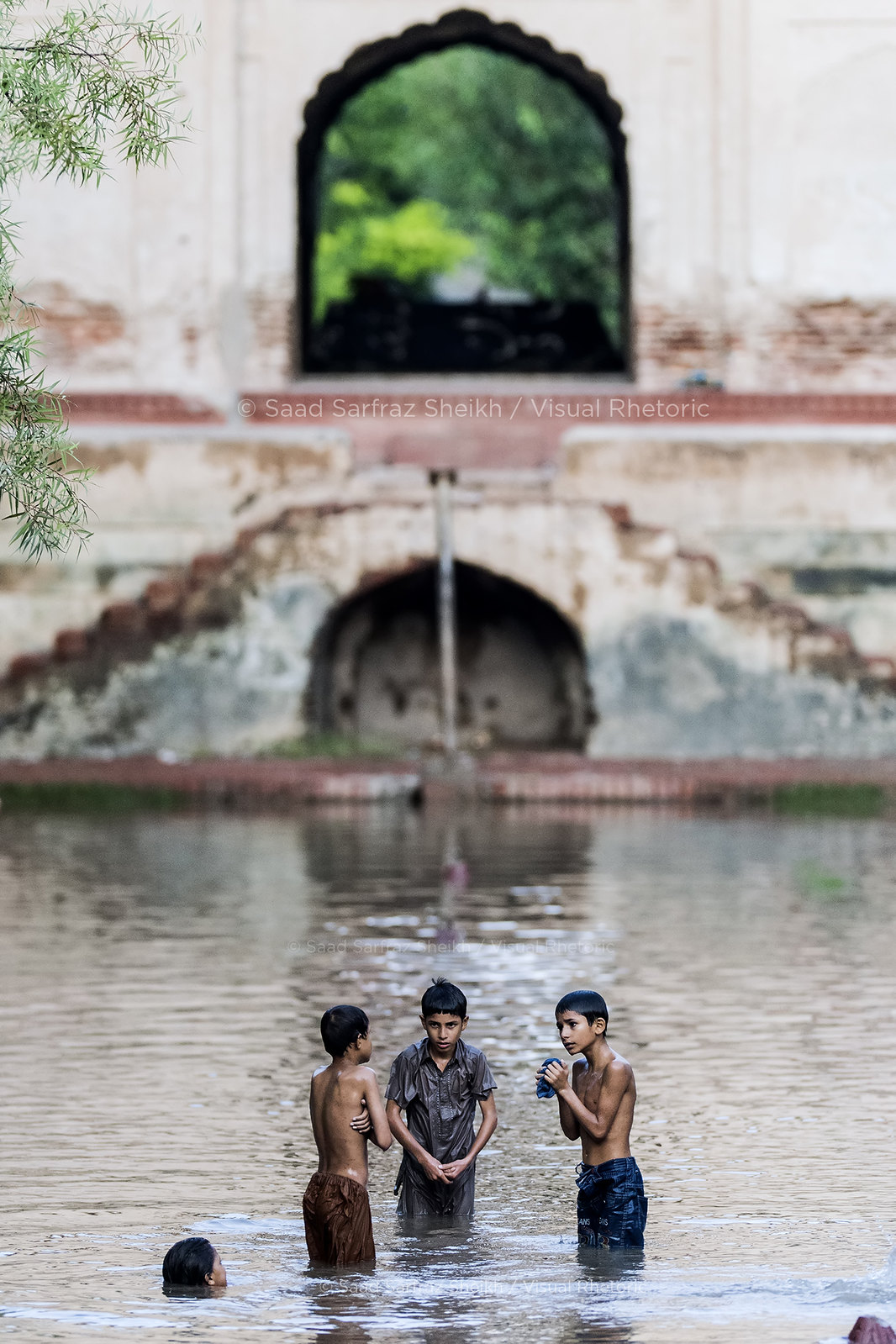
Now children play cricket under Nadira’s watchful eyes…

With endless rains, waters have surrounded her tomb and amid the floods, her tomb floats again…

The privilege of photography as a hobby

As is the case with most hobbies, photography is albeit a very costly one. It’s difficult to decide what you ‘want’, and what you really ‘need’.

I’m quite the answerable and have always had a hard time explaining to my non-photographer friends, the cost of a certain camera and lens. Back in 2008, when I bought my first DSLR, a Nikon D80, it cost me around $1200 with a kit lens. The same friends were shocked and complained how I could’ve bought a Macbook instead!

A decade down the road, having established myself as a professional photographer, my photography and gear have grown. Over the years, I’ve owned 100’s of lenses and a multitude of cameras. I recently splurged $5000 on a portrait lens. Wedding photographers here in Pakistan have spent a good $20-30,000 on bigger and costlier gear. There is certainly no limit, as they are also the ones who make the most with their profession!

Some of us have struggled over the years and feel great pride when we show off our photos and the costly gear that was used in the process. The rest of the majority are hobbyists who are more of collectors, diseased with GAS (Gear Acquisition Syndrome)

Amidst the hobbyist and the pros, there lies a third sect of photographers. We are not aware of their existence, as they are not photographers any more. This consists of people who were once photographers, or part of professional photography, but now have had to quit due to financial or personal reasons. In the last two years, on various trips to Pakistan and abroad, I’ve ran into such ‘ex-photographers’, each with a story of their own.

At a security check-post in Pakistan, I was stopped and asked to unzip my bag. I showed the security guard the contents of my bag and zipped it up again. I always get irritated when I am frisked at security check-posts and have to show the contents of my camera bag.  A press card gets me inside many places, beyond general public access, but owing to the worsening security situation, you cannot be excused from checking.  Upon seeing different lenses and cameras inside the bag, the security guard’s eyes sparkled. He told me that how he once used to be a photographer some years ago, but had to abandon it due to financial issues. “I covered a lot of events, but things were slow and I felt a job would give me more stability,” he explained.

I could almost feel his pain, but realised that he didn’t want an audience. He allowed me to proceed and I walked away with a heavy but “privileged” heart, thinking to myself,

“What if I had to abandon my photography some day?

Am I taking photography for granted?

Am I justifying my photographic equipment and time?”

The questions stuck around for some time, and then faded, until some days later, a photography assignment brought me to the capital of Pakistan, Islamabad.

The airport is a 45 minutes from the city, and the long and boring ride allows enough time to interact with taxi drivers. From a journalistic perspective, taxi drivers are always very interesting to talk to. They may not be reliable sources of information; but they interact with a lot people all day, are more open about their personal and professional lives, as they commute all day around the city, and are more aware of the problems and issues, and love to talk!

Afzal Masih is one such taxi driver in Islamabad. We became “friends” when he discovered that I was a journalist, after I showed my press card at a security check-point. He was even more excited to know that I was a photographer. It later turned out that he was once a wedding photographer, but had sold his photographic and studio equipment to buy his own taxi, as he felt it was financially “more viable”. He announced in a mix of Punjabi and Urdu “I started with the Nikon D70, but Nikon’s best camera was the D90, it had great results and I could shoot video too!” I was shocked to hear the names of cameras and lenses from a taxi driver!

And here he was, plying on the roads of the capital. It was difficult for me to visualise myself as a taxi driver, 10 years down the ‘road’, telling another photojournalist how I too once used to be a photographer. I’m sure Afzal too never thought he’d have to abandon his hobby/profession.  It also made me realise how easily the privileged under-estimate fellow human beings, based on their appearances, income levels, professions and ethnicity.

You look at a gardener who’s inspecting your camera from a distance, and instantly laugh to yourself, thinking what would this mere gardener know what you’re holding and what it is meant for.

I hope we as humans, as photographers, as hobbyists, can support the less privileged who share the similar, or greater passion for the arts. Maybe you could let someone you know/trust borrow your backup camera for some days. Or invite them on a shoot maybe. I’m sure a lot of our seniors have been kind to us over the years, and clichéd as it may sound, you should be kind to people on your way to the top, as you’ll be meeting them on your way down, or when they overtake you in the fateful years to come! Cheers!